Overview
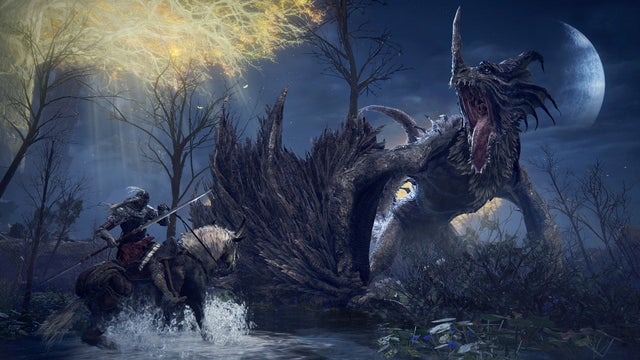
Elden Ring is FromSoftware's open-world action RPG, and it represents the moment the studio's punishing combat met genuine player freedom. You are a Tarnished arriving in the Lands Between with almost no direction, no map markers beyond a few graces, and no obligation to fight anything in a particular order. That freedom is the game's central gift: when a boss walls you, you can simply ride away, explore a legacy dungeon, gain levels, and return later stronger.
The combat retains the studio's signature weight. Every swing commits you to an animation, stamina governs both attack and defence, and healing is slow enough that panicking is punished. But the open field adds a strategic layer that previous games lacked — you can approach objectives from any angle, use the environment, and generally refuse to fight fair when fighting fair is not working.
The Core Loop
Explore a region, discover a dungeon or field boss, die to it several times, learn its tells, then either beat it or leave to become stronger. Sites of Grace act as checkpoints and fast-travel anchors, and resting at one resets the world's enemies while refilling your flasks. This loop is deliberately tuned so that death teaches rather than punishes — you lose runes, but you keep everything you learned.
Runes serve as both experience and currency. Banking them regularly at a Grace is the habit that removes most of the frustration from the early game; losing an hour of runes because you wanted one more corridor is a rite of passage nobody enjoys repeating.
Key Systems
Character builds revolve around eight stats, and understanding what each actually does prevents the most common wasted levels.
| Stat | Primary effect | Why it matters |
| --- | --- | --- | --- |
| Vigor | Health | The single best early investment |
| Mind | FP (magic) | Needed for casters and weapon skills |
| Endurance | Stamina and equip load | Governs how much you can act and carry |
| Strength | Heavy weapons | Scales big physical arms |
| Dexterity | Finesse weapons | Scales fast weapons and casting speed |
| Intelligence | Sorcery | Required for glintstone sorceries |
| Faith | Incantations | Powers holy and dragon spells |
| Arcane | Discovery and bleed | Scales status builds and item discovery |
Weapon scaling is tied to affinity. A weapon's letter grade indicates how strongly it scales with a given stat, and changing a weapon's affinity (via an Ash of War) alters both its scaling and sometimes its physical-versus-magic split. This is why two players using the same weapon can end up with completely different optimal stat spreads.
Equip load deserves special attention. Staying under the medium threshold preserves your standard roll; exceeding it produces the sluggish "fat roll," which is far less forgiving. Many defensive builds fail simply because they equipped armour without enough Endurance to carry it.
Strategy That Actually Works
Level Vigor early. This is the single most repeated piece of advice for good reason — extra health gives you room to make mistakes, and mistakes are how you learn boss patterns. A glass cannon that dies in two hits never gets enough practice reps.
Use the open world as a difficulty valve. If Margit or another early boss is beating you, ride south or east, clear minor dungeons, upgrade your weapon, and return. There is no shame in leaving; the game explicitly supports it, and most players who quit are those who believed they had to grind one specific wall.
Upgrade your weapon before your character. Smithing Stones are abundant in the early game and a leveled weapon provides more damage per rune than stats do. Most importantly, pick one weapon you like and commit — spreading upgrades across five weapons leaves you with five mediocre ones.
Use spirit ashes and summons if you want them. They are legitimate mechanics, and for many players they are the difference between finishing the game and abandoning it. Summons draw aggression, which creates the openings you need to actually study a boss's moveset.
Learn to dodge into attacks rather than away. Rolling away frequently keeps you inside an attack's lingering hitbox or leaves you unable to punish. Rolling toward the attack often puts you behind the boss during its recovery frames, which is where your damage windows live.
Common Mistakes
Spreading stats evenly across everything produces a character that is mediocre at all things. The second is ignoring equip load and fat-rolling without realising it. The third is hoarding consumables forever instead of using them during tough encounters.
The fourth is attacking continuously without watching stamina. Running out of stamina during a boss fight means you cannot roll out of the follow-up, and that is how most deaths actually occur — not from one big hit, but from being unable to escape the second one.
Getting Started
Pick the Vagabond or Samurai if you are unsure; both start with solid stats and workable equipment for a melee build, and neither locks you into a playstyle. Choose the Golden Seed or a useful starting gift, then ride Torrent and head outward rather than into the first big golden sentinel you see.
Do not rush the main path. The single best thing you can do in your first five hours is explore the starting region thoroughly, clear the minor camps and caves, and arrive at the first major boss genuinely stronger than the game expects you to be.
Best for players who enjoy difficult combat, discovery-driven exploration, and the satisfaction of overcoming a boss that genuinely outmatched them an hour earlier.
 RPG / Action