Overview
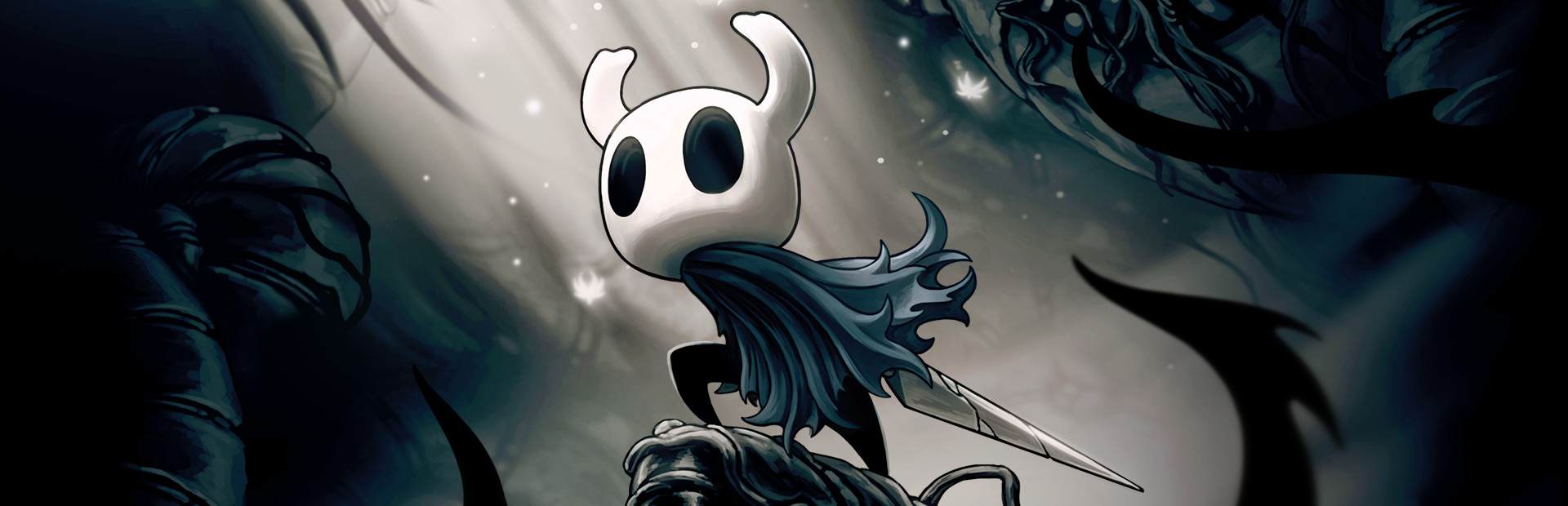
Hollow Knight sends a small silent knight into Hallownest, a fallen kingdom rendered in hand-drawn monochrome, and then refuses to tell you almost anything about it. There is no quest log, no objective marker, and barely any dialogue. What there is instead is one of the best-constructed maps in the genre: interlocking regions, ability-gated shortcuts, and secrets that reward curiosity rather than grinding.
Combat is deliberately restrained. You have a nail for melee, a few spells, and eventually a dash and a double jump. The depth comes from charm loadouts — equippable effects that all compete for a limited pool of notches, so every choice is a trade-off rather than an upgrade.

The Core Loop
Explore until you hit a wall, find the ability that breaks the wall, and use it to open several previously inaccessible areas at once. That is the metroidvania pattern, but Hollow Knight executes it unusually well because its abilities are movement tools rather than keys — the Mantis Claw, Monarch Wings, and Mothwing Cloak each rewrite how you traverse the entire map retroactively.
Bosses punctuate each region and most of them gate progression. Death sends you back to the last bench with your Geo dropped at a shade you must defeat to recover, which creates a genuine stakes system without permanent loss.
Key Systems
Charms are the build system, and notch cost is what makes them interesting.
| Charm | Notch cost | Effect | Best used for |
| --- | --- | --- | --- |
| Wayward Compass | 1 | Shows your location on the map | Early exploration, then drop it |
| Quick Slash | 3 | Faster nail swings | Any melee-focused build |
| Shaman Stone | 3 | Stronger spells | Spell-casting loadouts |
| Mark of Pride | 3 | Longer nail reach | Melee builds that want safe spacing |
| Fragile / Unbreakable Strength | 3 / 4 | Increased nail damage | Nearly every build |
| Spell Twister | 2 | Cheaper spells | Sustain-heavy caster setups |
The Geo economy is tight early. Buying the map, the quill, and the bench fast-travel points before anything else pays for itself many times over, and the bank exists specifically to stop you losing savings on death.
Strategy That Actually Works
Buy maps and map markers immediately in every new region. The game does not display your position without a charm, and wandering Hallownest without a map is the main reason players bounce off the first few hours.
Build for one approach at a time. A nail build wants Quick Slash, Mark of Pride, and Strength; a spell build wants Shaman Stone and Spell Twister. Splitting notches between both produces a character that does neither well.
Use the Dream Nail on enemies and on the environment. It reveals hidden dialogue, opens dream boss fights, and is required for several progression paths that are otherwise invisible.
Common Mistakes
The most common is refusing to retreat. Hallownest is built so that a wall usually means "go somewhere else first," and bashing against a boss you are under-equipped for wastes hours. Second is not buying the compass and quill, which turns exploration into frustration.
Third is hoarding Geo instead of spending it on bench fast travel and charm notches, both of which are permanent quality-of-life gains. Fourth is ignoring the upgrade paths — nail upgrades from the Nailsmith and vessel fragments for extra Soul are the real power curve, not level ups, because there are no levels.
Fifth is missing entire regions. Several major areas are hidden behind breakable walls or obscure paths, and finishing the game without ever finding them is entirely possible and much harder.

Getting Started
Take the Forgotten Crossroads slowly and buy the map, quill, and compass before exploring far. Rest at benches often to update your map and set your respawn point.
Upgrade your nail as soon as the Nailsmith can do it, since damage upgrades matter more than any charm early. Do not be afraid to walk away from a boss and return with more health upgrades and a better loadout. And hit walls with your nail more often than feels reasonable — Hallownest hides a surprising amount behind them.
Best for players who love discovery-driven exploration, tightly designed boss fights, and the kind of map that rewards you for remembering where a locked door was three hours ago.
Late-Game Content and Completion Paths
Hollow Knight extends well past the first ending. The Path of Pain, the Godhome pantheons, and the White Palace are all optional and all substantially harder than anything the main route requires. They are also where the best bosses in the game live, so players who enjoy the combat should plan to reach them.
Completing them effectively means finishing the build first: all nail upgrades, every vessel fragment, and a full charm loadout with the notch cost you can afford. Attempting Godhome with an incomplete nail and two spare notches makes it far harder than it is designed to be.
The lore payoff is concentrated in these areas too. Much of what actually happened in Hallownest is told through environment and item descriptions rather than dialogue, and the optional regions contain the clearest answers. For players who liked the atmosphere more than the difficulty, exploring them for the story alone is still worthwhile.
 Indie
Indie