Overview
Rocket League is, on paper, football played with rocket-powered cars, and in practice it is one of the purest skill-expression games ever made. The rules are trivially simple — put the ball in the net — but the mechanical ceiling is effectively infinite. There is no levelling system, no unlockable advantage, and no randomness: your rank reflects exactly what you can do with a car and a ball.
That purity explains its longevity. Every improvement is yours, which makes the grind rewarding and the losses instructive. It is also one of the few competitive games where a genuinely free-to-play, cross-platform player can reach the highest ranks without spending anything.
The Core Loop
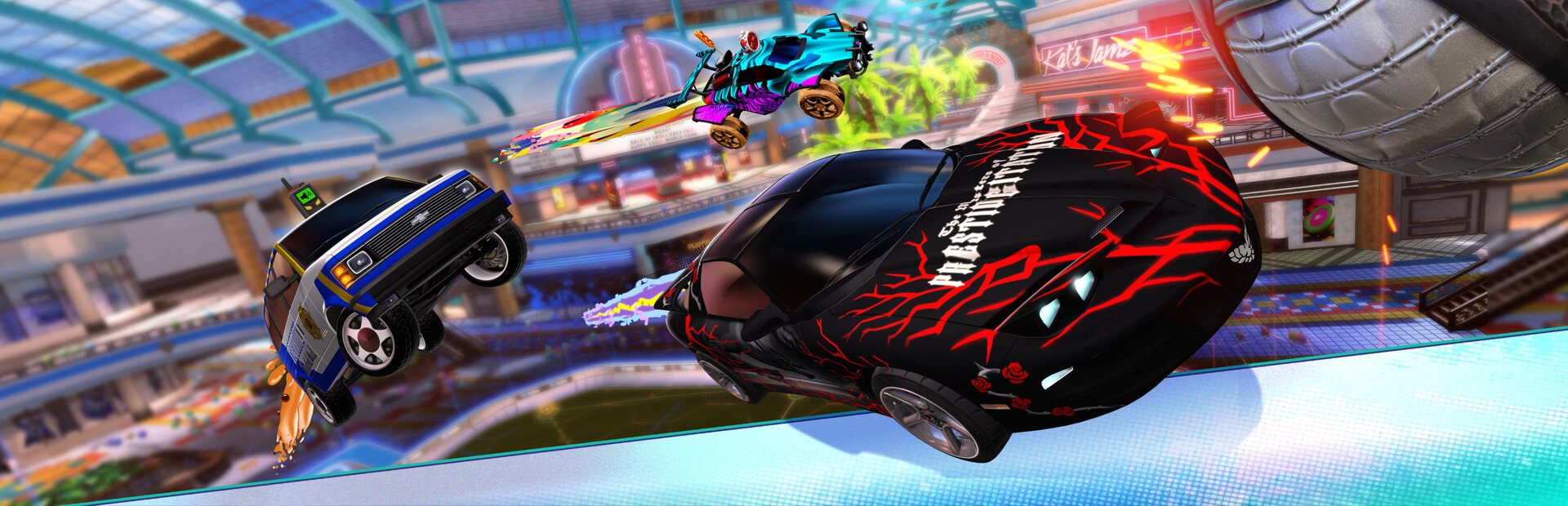
Matches are short — five minutes for standard play — and revolve around positioning, boost management, and aerial control. Teams of two or three rotate through roles, contesting the ball while maintaining defensive cover, and every goal is the result of several preceding decisions rather than a single moment.
Because matches are brief and queue times are low, improvement comes through volume. Playing twenty ranked matches teaches more than any guide, provided you review what went wrong. The most common structural error at every rank is teammates converging on the ball simultaneously instead of rotating.
Key Systems
Rotation is the foundational concept and the one most players misapply. In a standard three-player rotation, one player challenges the ball, then rotates away to the back post while the next teammate takes the challenge. This creates continuous pressure without leaving the net undefended.
| Concept | Meaning | Why it matters | Common error |
| --- | --- | --- | --- |
| Rotation | Cycling through challenge and support roles | Maintains pressure with defensive cover | Everyone chasing the ball |
| Boost management | Collecting and conserving boost pads | Enables aerials and fast challenges | Wasting boost on small pads unnecessarily |
| Positioning | Holding appropriate distance from the play | Allows both defence and counterattack | Ball-chasing or camping in goal |
| Aerial control | Flying to meet the ball in the air | Unlocks the full ceiling of play | Committing to aerials without boost |
Boost economy deserves specific attention. Small boost pads scattered across the field respawn quickly and travelling over them while rotating keeps you supplied without abandoning the play. Large boost orbs are valuable but often require leaving your position, which can concede a goal.
Car control — powerslide turning, half-flips, diagonal dodges, and wave dashes — is the mechanical layer. These techniques reduce the time needed to reposition and are what separate mechanically developed players from those who rely on positioning alone.
Strategy That Actually Works
Learn to rotate to the back post rather than the near post. Defending from the far side of the goal gives you a wider view of the play and lets you cover shots from angles you could not otherwise reach. This single habit fixes a large share of defensive breakdowns.
Do not commit as the last man. If both teammates are already forward, your job is to defend, not to join the attack. Teams concede most goals because the third player abandoned the defensive position at the wrong moment.
Practise basic mechanics in free play rather than in matches. Ten minutes of deliberate practice — aerial attempts, powerslide turns, recovery landings — before playing is more effective than twenty extra matches where you only repeat what you can already do.
Learn to read bounces. Predicting where the ball will go off a wall or the curved corners lets you arrive early, which is far easier than reacting late. Bounce reads are the most transferable skill across every rank.
Common Mistakes
Ball-chasing is the defining error at lower ranks and it persists deceptively long. The second is double-committing, where two players go for the same ball and leave the net empty.
The third is over-committing to aerials without sufficient boost, which leaves you out of position for a long recovery. The fourth is ignoring the clock and boost levels when deciding whether to attack — chasing a goal with no boost in the final seconds usually concedes instead.

Getting Started
Adjust camera and controller settings early through community-recommended presets; default settings are workable but rarely optimal. Lower camera shake, widen your field of view, and set powerslide to an easily accessible button.
Play casual matches learning only rotation for your first twenty hours. Everything else — aerials, dribbling, flip resets — builds on the foundation of being in the right place. Supplement with free-play drills and simple training packs.
Best for players who want a pure competitive experience where improvement is entirely self-driven and every goal reflects decisions made thirty seconds earlier.