Overview
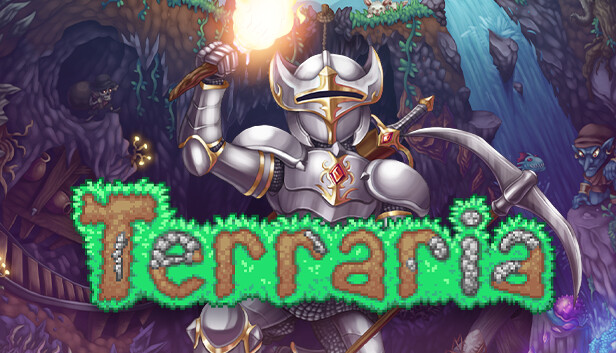
Terraria looks like a simple side-scrolling building game for its first ten minutes and then quietly becomes one of the deepest progression sandboxes ever made. You spawn with a copper shortsword, a pickaxe, and a guide who will explain almost everything if you ask him. What follows is a loop of mine, craft, build, fight a boss, unlock a new tier of ore, and repeat — but the boss gates are what give the game its shape. Each boss you defeat changes the world: new NPCs arrive, new biomes spawn, and new materials become available.
The single most important mechanical distinction is between pre-Hardmode and Hardmode. Defeating the Wall of Flesh permanently flips your world into Hardmode, spawning a diagonal band of the Hallow and the Corruption or Crimson that spreads aggressively and introducing far deadlier enemies. Everything before that moment is a long tutorial, and everything after is where the real build crafting begins.
The Core Loop
A typical session runs in three beats. First you explore horizontally and vertically, opening chests and gathering surface loot to establish a safe home base with NPC housing. Second you dig, following ore tiers from copper up through iron, silver, gold or platinum, and eventually the rarer materials gated behind boss kills. Third you craft an arena and summon a boss, then spend the reward materials on the next tier of armor and weapons.
Arena building is the skill most new players underestimate. A flat platform with campfires, heart lanterns, and a bast statue turns a fight that felt impossible into a manageable dance. Bosses in Terraria are largely movement puzzles — you are not out-damaging them, you are out-positioning them — and the arena is what gives you the room to do that.
Key Systems
Class choice matters more in Terraria than it first appears. Weapons are not interchangeable; they draw on distinct armor sets and accessories that stop stacking once you commit.
| Class | Core weapon | Key armor tier | Main weakness |
| --- | --- | --- | --- |
| Melee | Swords, yoyos, flails | Turtle / Beetle | Requires close range, punishes poor positioning |
| Ranged | Bows, guns, launchers | Shroomite | Consumes ammunition, needs a farm |
| Magic | Staves, spell books | Spectre | Mana management and low defense |
| Summoner | Minion staves, whips | Spooky / Stardust | Weak early, scales hardest late |
Accessories are the true power curve. Reforging them to Warding or Menacing, then combining them into higher-tier tokens, produces a larger jump than any single weapon upgrade. The Ankh Shield, Terraspark Boots, and Celestial Shell are the kind of quality-of-life items that permanently change how the game feels to move around in.
Strategy That Actually Works
Prepare for Hardmode before you trigger it. Build quarantining tunnels several blocks wide around your base and around the biomes you care about, because the new evil biome spread will otherwise consume the world faster than you can push it back. Stockpile the materials you will need immediately after the Wall of Flesh dies, since the difficulty jump is steep and you do not want to be mining Hellstone-tier ore in a world full of new threats.
Fishing is the single most underrated progression shortcut. Crates obtained through fishing can be opened in bulk after entering Hardmode and will grant Hardmode ores without any mining, which skips hours of grinding. A dedicated fishing character or a well-placed fishing hole pays for itself across an entire playthrough.
Event farming beats boss rushing when you are under-geared. The Goblin Army, the Old One's Army, and the Blood Moon all drop useful accessories and provide a safer source of materials than a boss you are not ready for.
Common Mistakes
The classic error is entering Hardmode with no plan and immediately losing your NPC town to biome spread. The second is spreading accessories across conflicting classes, which produces a character that is mediocre at everything. Third is ignoring potions: buff potions in Terraria are not optional niceties, they are the difference between a boss taking three minutes and taking thirty seconds.
Fourth is mining without a hellevator or a proper tunnel network, which wastes enormous amounts of time backtracking. Finally, many players never build a proper arena and conclude that a boss is unfair, when the real problem is that they fought it on uneven ground with no buffs.
Getting Started
Start on a normal-difficulty small or medium world and do not enable any secret seed modifiers on your first run. Build housing early so NPCs arrive, because the Merchant and the Dryad are what make early survival comfortable. Follow theGuide's crafting hints — he genuinely surfaces the next step in the chain whenever you hand him a material.
Pick a class by the time you reach gold or platinum armor and commit to it. Fight bosses in order rather than skipping ahead, and treat Hardmode as a new game rather than a continuation. Above all, build the arena first; nearly every wall players hit in Terraria is a preparation problem rather than a mechanical one.
Best for players who enjoy deep crafting trees, boss-gated progression, and the specific satisfaction of preparing so thoroughly that a fight you once found impossible becomes routine.
 Sandbox